It's the last Friday of term. The book bag has a letter in it about a non-uniform day that already happened, and somebody in the kitchen asks what we're doing next week. Nobody answers properly, because next week is currently a vague sense that it'll be fine, one holiday club nobody has booked, and a promise made in September about going to the cinema.
October half-term is short enough to feel like it doesn't need planning, and long enough to go badly wrong if you don't. Twenty minutes on that Friday sorts it.
It's nine days, not five
Two working parents look at half-term and count the working days: five to cover, minus whatever leave you've already booked. Children count differently. For them it starts when they walk out of school and ends when they walk back in, which is nine days including both weekends.
Those weekends are where the trouble hides. They're the ones that fill up with a birthday party, a trip to see grandparents, and the friend who says "come over any day next week, we're around". Plan the five and the nine will ambush you.
So write all nine on one page, Saturday through to the Sunday. One sheet, one week, both weekends.
A quick warning before you write dates on anything: half-term falls in late October, but the exact week isn't the same everywhere. Councils publish their own term dates, academies and independent schools sometimes set their own, and if you've got children in two different schools you may not get the same week. Check your council's term dates page and your school's own calendar before you book a single thing.
Do it on the Friday, not the Sunday night
The Friday before is the last moment when you can still fix things. Clubs still have places. Grandparents haven't made other plans. Your manager can still move a meeting. By Sunday night you're not planning half-term, you're finding out about it.
It also means the children are in the room. Twenty minutes after school on the last Friday of term, with everyone slightly giddy, is a better planning meeting than you'd think. They'll tell you which day matters to them, which is worth knowing before you spend money on one that doesn't.
Put a name on every day
This is the bit that does the work. Not "holiday club?" with a question mark. A person, written in the box: me, you, Mum, Grandad, Katie's mum, holiday club with you doing drop-off.
“Half-term rarely goes wrong because you booked the wrong club. It goes wrong because nobody said out loud who was covering Wednesday.”
When you name every day out loud, the gaps show up in about ninety seconds. Usually there are one or two, and usually they're solvable on a Friday: swap a leave day, ask the grandparents while they still have an empty week, offer another family a day in exchange for one of theirs. It's the same principle as the Sunday reset, just scaled up to a fortnight.
If the cover is split across two households, do it together rather than each planning your own half and comparing later — there's more on that in the co-parenting post.
Cost it before you book it, not after
Half-term money goes in small, invisible pieces: club fees per child per day, the day out where the tickets were the cheap part, petrol, lunch out because you're already in town, the soft play on the wet day. Nobody decides to spend it. It just happens, and you notice in November.
So put a cost column next to the nine days and write a number in it, even a rough one, before anything is booked. Then look at the total. The useful move is almost never cancelling everything — it's spotting that three days in a row are expensive and turning the middle one into a park, a library and a film at home. Cheap days are much easier to plan on a Friday than to improvise on a Tuesday.
Leave one day completely empty
Pick one weekday and put nothing in it. No club, no trip, no admin, no "we could just pop to". Half-term always overruns: something gets cancelled, someone gets a temperature, a day out takes two days to recover from. The empty day is where all of that lands.
If you plan nine full days, you don't get nine good days. You get seven good ones and two you spend apologising to each other.
- All nine days written down, both weekends included
- A named person for every day, out loud
- Clubs booked, not "looked at"
- Grandparents asked while their week is still free
- Rough cost next to each day, then totalled
- One weekday left deliberately empty
- Work told which days you're off, before the diary fills
Take the sheet
Paper is the right tool for this one, because it goes on the fridge and everyone walks past the fridge.
Fill it in on the Friday, stick it up, and let people read it instead of asking you. Half the mental load of a school holiday is being the only person who knows the plan — something I've written about in the invisible job.
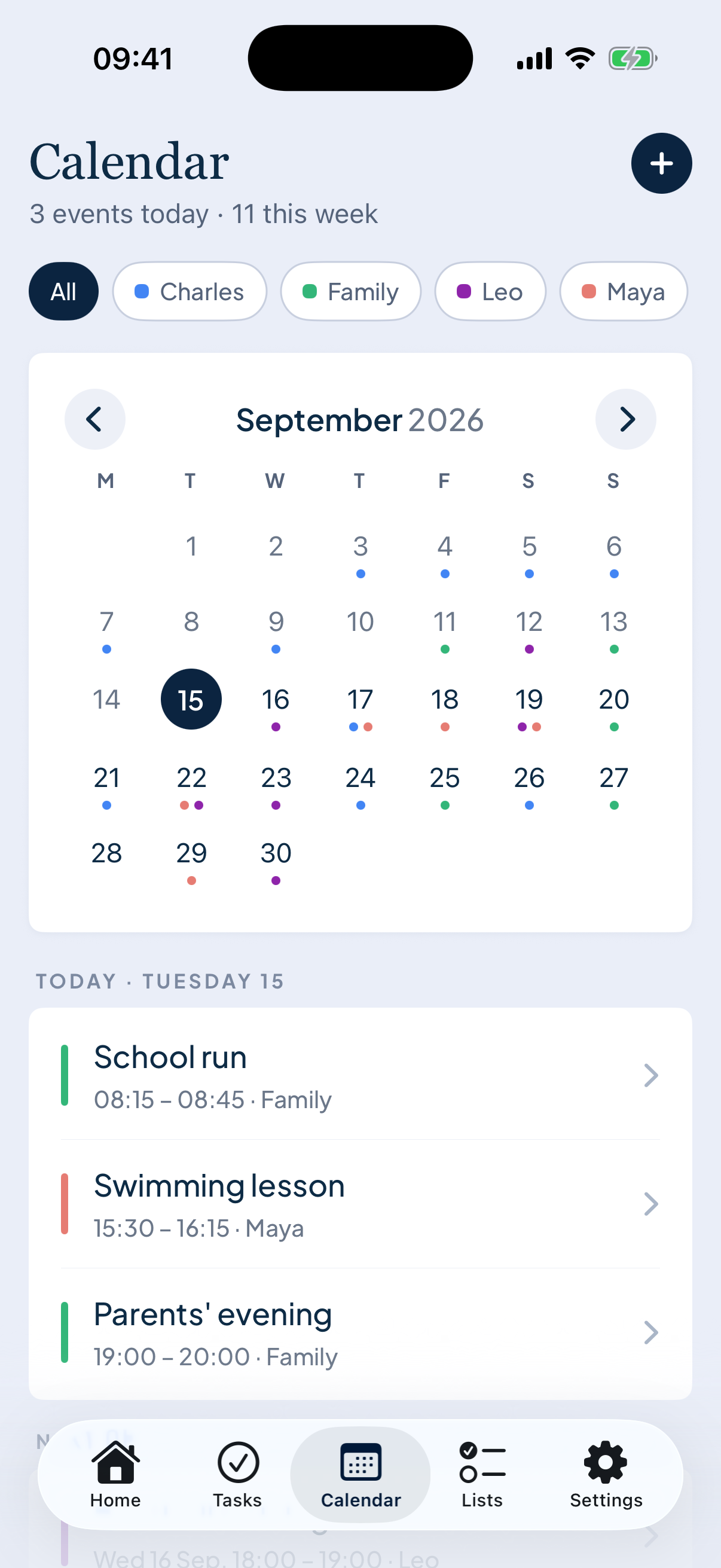
Once it's agreed, it's worth putting the nine days somewhere everyone can see them without asking you. That's what I built Noa for: one shared calendar for the household, with a colour for each person and reminders on the things that need booking. But the fridge works too — the planning is the part that matters, not where it ends up.