It always arrives at the same time. Everyone's in bed, the kitchen is finally quiet, and someone remembers the swimming money. Or the non-uniform day. Or that Thursday has a parents' evening in it that nobody wrote down.
The problem usually isn't that anyone is disorganised. It's that the week lives in several heads at once, and only one of them is awake at ten o'clock.
What the twenty minutes actually is
Sunday, after dinner, before anyone starts a film. One person reads the week out loud, Monday to Sunday. That's it.
The reading out loud is the bit that works, because it's the only version where everyone hears the same week. A shared calendar you each glance at on your own is useful. A shared calendar someone reads to the room is a plan.
- Read the week out loud, Monday to Sunday
- Name who is doing each thing, out loud, not in your head
- Put the money, forms and kit in the bag on Sunday, not on the day
- Agree the one night nobody schedules anything
Say who, not just what
"Swimming, Wednesday" is a fact. "Swimming, Wednesday, you're on pickup" is a plan. Most Sunday-night arguments aren't really about the diary. They're about the gap between knowing something is happening and knowing it's yours.
So name a person for everything that needs one. If nobody can take it, you find out on Sunday, when there's time to ask a grandparent or swap a shift, instead of at 8.40 on Wednesday.
“The reset doesn't make the week any emptier. It just moves the panic to a time when everyone's awake enough to deal with it.”
Pack it on Sunday
Anything that has to physically leave the house this week gets dealt with now: the envelope with the trip money, the signed form, the recorder that's lived under the sofa since June. Bags by the door on Sunday night means Monday morning is just shoes and coats.
It sounds small. It's the part that saves the most shouting.
Protect one empty evening
The last step is the one most people skip, and the one I'd fight for. Pick one weeknight and agree that nothing goes in it. No clubs, no admin, no "quick" favour. When the week fills up, as it always does, that evening is where the slack lives.
What not to bother with
A few things sound sensible and quietly kill the routine:
Colour-coding everything. It looks lovely for a fortnight. Give each person one colour and leave it there.
Planning meals in the same sitting. It turns twenty minutes into an hour, and nobody sits through an hour. Give meals their own ten minutes on a different day.
Doing it perfectly. Some Sundays it's four minutes over the washing-up. That still counts.
Take the sheet if you want it
Paper is a good way to start. The sheet is one side of A4: seven boxes, a column for who, and a line at the bottom for the quiet night.
Three Sundays in, you'll stop needing the sheet. That's the thing nobody tells you about routines: the good ones make themselves unnecessary.
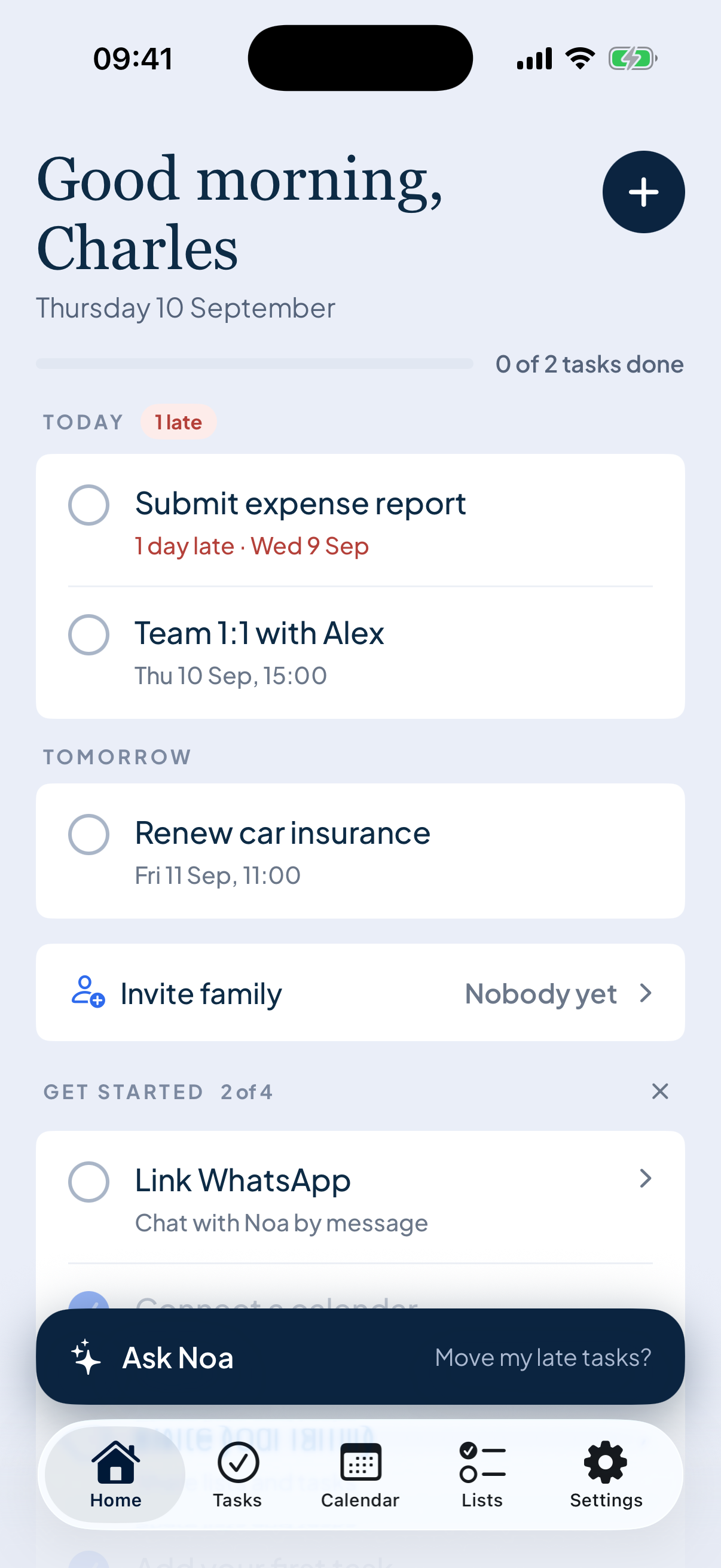
If you want the week in one place for everyone, that's what I built Noa for. And if you'd rather stick with paper, the sheet above works just as well.