It's 8.12 and the morning has already split in two. One child is dressed, fed and watching telly with their coat on. The other is halfway up the stairs in one sock, shouting a question about whether today is swimming. Somewhere on the kitchen worktop there's a letter that needed signing yesterday, under a bowl.
Almost none of that is a morning problem. It's an evening problem that waited until morning to introduce itself.
The morning is decided at seven the night before
Here's the thing about school mornings: there is no spare time in them. Whatever cushion you build gets eaten. Get everyone up twenty minutes earlier and you will leave at exactly the same time, just more tired, because the twenty minutes fills with dawdling and a conversation about Roblox.
So the fix isn't more time. It's fewer decisions. A school morning that runs on its own is a morning where nothing has to be worked out — where the only tasks left are physical ones: shoes, coat, door.
That means moving the thinking to the evening, when someone is still awake enough to do it. Three decisions, five minutes, done after dinner or during the bedtime shuffle.
- Clothes out, socks included, in a pile you can see from the door
- Bags packed and zipped: kit, reading record, forms, money
- Breakfast named out loud, so nobody chooses at 7.40
Decision one: clothes, and the socks are the point
A full outfit on the floor or the end of the bed. Not "the uniform's in the drawer" — an actual pile, visible, with socks on top.
Socks are where mornings die. Everything else in a school uniform exists in one obvious place; socks live in a quantum state somewhere between the clean washing, the radiator and under the bed. Sorting them at 7.50 costs four minutes and one raised voice. Sorting them at 7.30pm costs nothing, because nobody is late for anything.
The other half of this decision is checking the day. Is it PE? Forest school? Own clothes for the harvest thing? That's a calendar question, and it's much easier to answer the night before than to answer in a dressing gown.
Decision two: the bag gets zipped tonight
Anything that has to physically leave the house tomorrow goes in the bag before bed. Reading record, water bottle, the envelope with the trip money, the form you've now signed, the recorder that's been under the sofa since June.
Bags by the door, zipped. Not "by the stairs" or "on the chair" — the door, in a spot that never changes. The reason to be fussy about the spot is that it means nobody has to remember where the bag is; they only have to walk past it.
This is also where the week's school admin quietly lands. If you're the one who reads every email from the office, you already know that most of it ends in an object: a costume, a pound coin, a permission slip. Dealing with school admin in one weekly sitting keeps those from arriving as surprises at 8.05.
“A school morning doesn't go wrong at 8.10. It goes wrong at 7.40 the night before, when nobody decided anything.”
Decision three: breakfast is a decision, not a menu
Choice is lovely at the weekend. On a Tuesday it's a negotiation with someone who has no concept of time and strong feelings about the wrong bowl.
Name breakfast the night before — "toast and a banana", "the cereal, in the blue bowl" — and put the bits where they'll be needed. Bowls out. Cereal on the side. If someone eats in the car, it's decided and wrapped before bed, not improvised while you're looking for keys.
You don't need a rota or a meal plan for this. It's one sentence said out loud. If breakfast is genuinely a weekly battle, that's a meal planning problem rather than a morning one, and it should be solved on a Sunday.
The one rule for the car
Nothing new gets raised in the car.
No announcements about Thursday's dentist appointment. No "by the way, you've got a party on Saturday, what shall we get her?" No quizzing about spellings. No asking who's doing pickup, because that conversation at 8.35 is just two people being stressed in a confined space.
The car — or the walk, or the bus — is the last ten minutes before everyone splits off for the day, and it's the only ten minutes that can't be rescheduled. Protect it. Information handed over in a car is also information nobody remembers: it goes in one ear and straight out of the window with the crisps.
If something occurs to you on the way, hold it. Say it at dinner, where there's a calendar and a kettle and someone can actually act on it.
Three things that look like fixes and aren't
A laminated morning timetable on the wall. Beautiful for a fortnight. Children stop seeing anything that doesn't move.
Waking everyone earlier. Already covered: the time fills. If you must shift anything, shift bedtime.
Making one parent the morning. A single person holding clothes, bags, breakfast, shoes and the door is not a routine, it's a bottleneck — and it's exactly the kind of invisible job that breeds resentment by Wednesday. Split it by job, not by child: one of you owns the bags, the other owns breakfast and shoes.
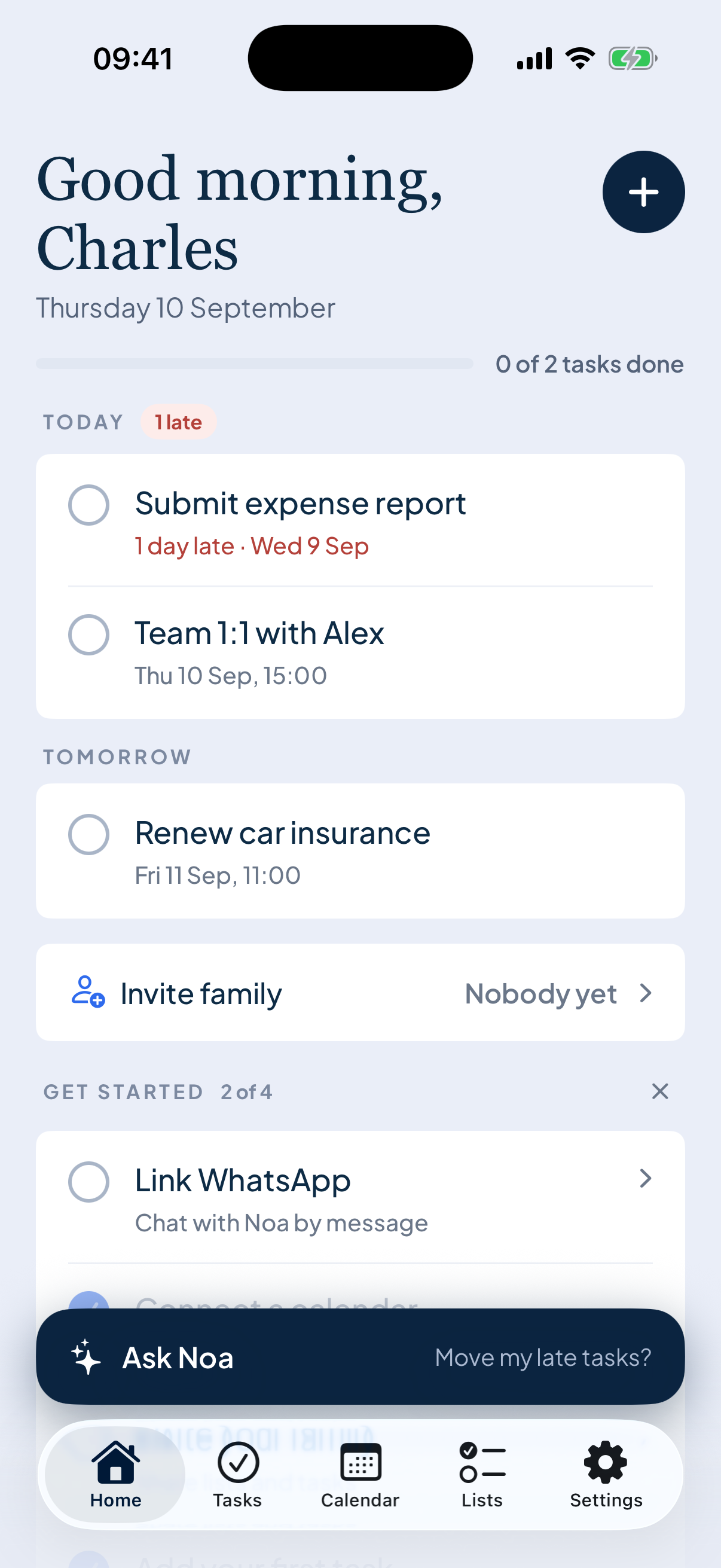
The three decisions take five minutes, and they only work if everyone's looking at the same day. That's what the shared calendar in Noa is for — PE on a Thursday, set to repeat, with a reminder the evening before, so the socks get found while everyone's still awake.